
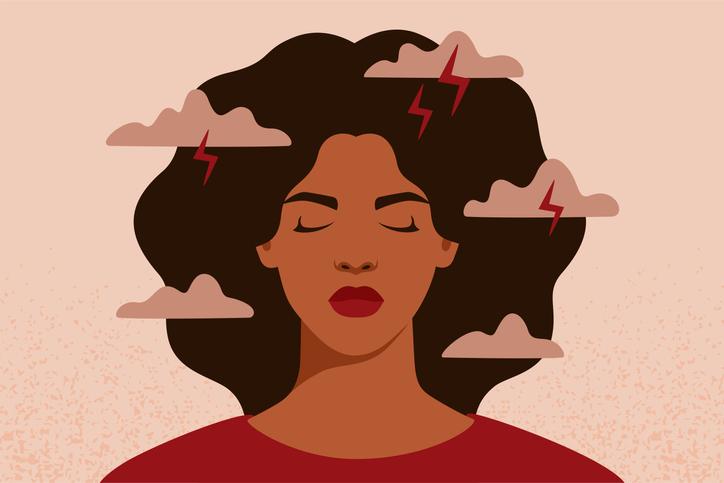
The Female Migraine
Migraine is significantly more prevalent in women than in men, affecting 18% of women and 6% of men globally.1 Its symptoms appear to shift with fluctuating female sex hormone levels during a woman’s life course.1 Ongoing studies are starting to unravel possible mechanisms of how migraine may impact women at their various life stages in unique ways.2
Sex differences in migraine prevalence
More women are affected by migraine compared with men throughout the lifespan, with differences emerging after puberty and peaking at an increased prevalence 3.25 times greater in women compared with men in the age group of 18 to 29 years.3 From adolescence onward, women present a higher level of headache-related disability and burden of disease compared with men.3 Women may also have a higher risk of transitioning to chronic migraine.4

Neuroimaging studies in humans have shown increased sex-specific activity in particular areas of the brain involved in pain processing (insula and precuneus), but the basis of these sex differences is still not well understood.5 While a number of, and an interplay of, both genetic and non-genetic factors contribute to sex differences in migraine pathogenesis, the current body of evidence suggests that the role of sex-specific hormones plays a major part.1
Impact of hormones on women with migraine
Growing evidence suggests estrogen is a major player in migraine.1 Female gonadal hormones increase the susceptibility to migraine in animal models, which can be abrogated by ovariectomy.6 Women who are obese appear to have a greater than two-fold risk of migraine compared to non-obese women, which is hypothesized to be related to pathological estrogen production in adipose tissue.5 Ongoing studies are continuing today to elucidate mechanisms involved in the relationship between estrogen and migraine.1
One possible link between estrogen and migraine pathogenesis lies in the serotonergic system.5 Estrogen enhances serotonin neurotransmission, which has a crucial role in migraine pathogenesis.7 Another link that has emerged is calcitonin gene-related peptide (CGRP) release, another major contributor to migraine pathology, which also appears to be modulated by fluctuating estrogen levels.8 Several studies have indicated a connection between estrogen (and other female sex hormones) and CGRP levels, along with homeostasis of the trigeminovascular system, which remains an active area of research.2
In contrast to estrogen, testosterone can suppress migraine in animal models via androgen receptor signaling,9 though its effect in humans is not yet clear due to a lack of relevant studies. Likewise, the role of progesterone and other sex‑specific hormones have been less thoroughly studied, though some existing data suggest there are connections to migraine.5 Though further investigation is necessary, it is evident that hormones are critical in understanding sex differences in migraine.

Migraine in specific life stages of women
MIGRAINE IN MENARCHE AND ADOLESCENCE
Sex differences in migraine prevalence emerge at the start of puberty and increase over the course of adolescence.1 The incidence of migraine with aura is greatest around 12–13 years old, whereas that of migraine without aura is a few years later, which could be related to unique ovulation patterns and related hormonal changes associated with menarche.5 Despite this, treatment of adolescent migraine remains a challenge due to limited data, and a lack of specific guidelines for the management of pediatric migraine.1 Medication can be used both symptomatically and preventively, but clinicians must be cautious of certain classes of drugs that may be teratogenic.1

MENSTRUAL MIGRAINE
Menstrual migraine (MM), which encompasses both pure MM and menstrually related migraine (MRM), is more severe, longer lasting, less responsive to medication, and more likely to be associated with disability than non-menstrually related migraine (NMRM).10 MM attacks are classified as presenting up to 2 days prior to, during, and/or up to 3 days after menstruation and occurring in at least 2 out of 3 cycles.11 Typically, MM presents without aura, and while only 7% to 35% of women experience pure MM, 60% of women experience MRM.1
Abrupt decrease in estrogen levels in the luteal phase are thought to trigger MM attacks, known as the “estrogen withdrawal hypothesis”.8 Because MM is not responsive to classic medication, temporally targeted preventive hormonal therapy, such as estrogen implants, is more effective.12 Interestingly, genomic studies have revealed that MRM is defined by unique gene expression patterns distinct from NMRM, which may help identify biomarkers in the future.13
HORMONAL TREATMENT AND RISK OF STROKE
Hormonal contraceptives are heterogenous in hormone ingredients, types, amount, mode of delivery, and dosage; administration can improve, worsen, or have no impact on migraine.1 Generally, most hormonal contraceptives have been accepted as no-risk products for patients with migraine without aura or with simple aura.1
Patients who have migraine with aura, however, are cautioned against using hormonal contraceptives because the risk of ischemic stroke has been suggested by several studies.1 However, the evidence remains controversial, and detailed analyses are ongoing to clarify if the risks are significant so that informed recommendations can be made.1

MIGRAINE IN PREGNANCY, POSTPARTUM, AND LACTATION
Migraine usually affects women during childbearing years, and an important consideration for clinicians is choosing safe medications with the least possible teratogenic risk, if symptoms warrant the use of medications.1 While hormonal changes during pregnancy can impact migraine in unpredictable ways, more than 80% of women with migraine without aura report improved symptoms over the second and third trimesters after some worsening in early pregnancy.14 Importantly, in pregnancy and the postpartum period, precise distinctions must be made between migraine and various pregnancy-related secondary headache disorders.1 Generally, non-pharmacological therapies are recommended if symptoms are not severe.14
With the rapid drop of estrogen levels after delivery, women often experience the return of migraine symptoms during the postpartum and lactation period.1 Special considerations are required for the use of migraine medications during breast-feeding.14 Acute or preventive treatment, if needed, should be carefully decided by considering the benefits and risks for both mother and child.14
MIGRAINE IN PERIMENOPAUSE AND MENOPAUSE
Symptoms of MM tend to improve with age as women approach menopause, but the interplay of migraine with perimenopausal symptoms can be complicated, leading to worsening of symptoms for a subset of migraineurs.8 Whether hormone replacement therapy (HRT) has a beneficial effect on migraine is still unclear due to inconsistent data, and needs to be elaborated on.1 Post-menopause, many women experience alleviation of their migraine symptoms, as their hormone levels (namely estrogen) drop and stabilize.1

Further research on migraine in women is crucial
The constantly fluctuating nature of female sex hormones is clearly closely linked to migraine, yet unfortunately remains a relatively under-studied area. Women experience migraine through their lives in a different way from men, and future studies should urgently focus more on how both women and men with migraine can benefit from expanded knowledge about sex-specific management recommendations.
References
-
Lagman-Bartolome AM, Lay C. Migraine in Women. Neurol Clin 2019;37(4):835–45.
-
Labastida-Ramírez A, Rubio-Beltrán E, Villalón CM, MaassenVanDenBrink A. Gender aspects of CGRP in migraine. Cephalalgia 2019;39(3):435–44.
-
Buse DC, Loder EW, Gorman JA, et al. Sex Differences in the Prevalence, Symptoms, and Associated Features of Migraine, Probable Migraine and Other Severe Headache: Results of the American Migraine Prevalence and Prevention (AMPP) Study. Headache: The Journal of Head and Face Pain 2013;53(8):1278–99.
-
Schroeder RA, Brandes J, Buse DC, et al. Sex and Gender Differences in Migraine-Evaluating Knowledge Gaps. J Womens Health (Larchmt) 2018;27(8):965–73.
-
Delaruelle Z, Ivanova TA, Khan S, et al. Male and female sex hormones in primary headaches. J Headache Pain 2018;19(1):117.
-
Eikermann-Haerter K, Dileköz E, Kudo C, et al. Genetic and hormonal factors modulate spreading depression and transient hemiparesis in mouse models of familial hemiplegic migraine type 1. J Clin Invest 2009;119(1):99–109.
-
Martin VT, Behbehani M. Ovarian hormones and migraine headache: understanding mechanisms and pathogenesis--part I. Headache 2006;46(1):3–23.
-
Pavlovic JM, Akcali D, Bolay H, Bernstein C, Maleki N. Sex-related influences in migraine. Journal of Neuroscience Research 2017;95(1–2):587–93.
-
Eikermann-Haerter K, Baum MJ, Ferrari MD, van den Maagdenberg AMJM, Moskowitz MA, Ayata C. Androgenic suppression of spreading depression in familial hemiplegic migraine type 1 mutant mice. Ann Neurol 2009;66(4):564–8.
-
Pinkerman B, Holroyd K. Menstrual and nonmenstrual migraines differ in women with menstrually-related migraine. Cephalalgia 2010;30(10):1187–94.
-
Headache Classification Committee of the International Headache Society (IHS) The International Classification of Headache Disorders, 3rd edition. Cephalalgia 2018;38(1):1–211.
-
Magos AL, Zilkha KJ, Studd JW. Treatment of menstrual migraine by oestradiol implants. Journal of Neurology, Neurosurgery & Psychiatry 1983;46(11):1044–6.
-
Hershey A, Horn P, Kabbouche M, O’Brien H, Powers S. Genomic Expression Patterns in Menstrual-Related Migraine in Adolescents. Headache: The Journal of Head and Face Pain 2012;52(1):68–79.
-
Robbins MS. Headache in Pregnancy. Continuum (Minneap Minn) 2018;24(4, Headache):1092–107.



רוצים להמשיך לקרוא?
הירשמו עכשיו בקלות ובמהירות לאתר התוכן של טבע ישראל לקהל הרפואי ותקבלו גישה לכל התכנים
להרשמהאת.ה עומד.ת לעזוב את העמוד
האם את.ה בטוח.ה?